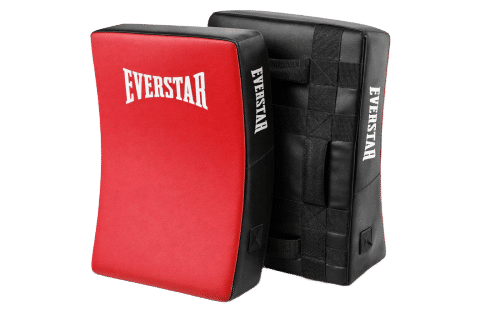
Genuine leather is what separates a glove that lasts three months from one that lasts three years. The premium Everstar leather glove uses full-grain cowhide over a multi-layer moulded foam core, so the padding compresses evenly instead of packing down into a hard lump across the knuckles the way cheaper synthetic fillers tend to after a few hundred rounds on the bag.
If you train more than twice a week, this is the glove worth buying. Leather breathes, which means the inner lining dries between sessions rather than staying damp and breaking down. It also moulds to your hand over the first few weeks, so the fit gets better with use rather than worse.
Choosing your weight
Glove weight is about padding, not glove size. A heavier glove has more protective foam — it does not mean a bigger hand fits inside it. Most adults need two pairs eventually: a lighter pair for bag and pad work, and a heavier pair for sparring.
- 8oz — Competition weight for lighter divisions. Minimal padding, maximum feedback. Not for sparring.
- 10oz — Competition and speed work. Popular with smaller adults and anyone doing fast pad rounds.
- 12oz — The most versatile all-round weight. Good for pads, bag work and technical drilling. A common first pair for women and lighter men.
- 14oz — General training and light sparring. A sensible single-pair choice if you only want to buy once.
- 16oz — The sparring standard. Most boxing gyms in South Africa require 16oz for any contact sparring, regardless of your bodyweight. If your coach has told you to bring sparring gloves, this is what they mean.
As a rough guide: under 60kg start at 10–12oz, 60–75kg at 12–14oz, and over 75kg at 14–16oz. When you are between two weights, size up. The extra ounce protects your training partner as much as it protects you.
Leather vs synthetic
Synthetic gloves are the right call for a beginner who is not yet sure they will stick with boxing, or for a school or club buying twenty pairs on a fixed budget. They cost less and perform perfectly well for casual use.
Leather earns its price over time. It resists cracking at the flex points, holds its shape through repeated heavy impact, and handles sweat far better. If you are training seriously, competing, or you have already worn out one synthetic pair, the leather glove is the cheaper option measured per session.
Care and lifespan
Never leave gloves inside a closed gym bag. Trapped moisture is the single fastest way to destroy the inner lining and create the smell that never comes out. Pull them out the moment you get home and stand them palm-up somewhere with airflow.
Wipe the outer leather with a barely damp cloth after training and let it air dry away from direct sun and heat — a car boot or a radiator will dry the leather out and crack it. Always wear hand wraps underneath; wraps absorb the sweat that would otherwise soak straight into the padding, and they roughly double the working life of the glove.