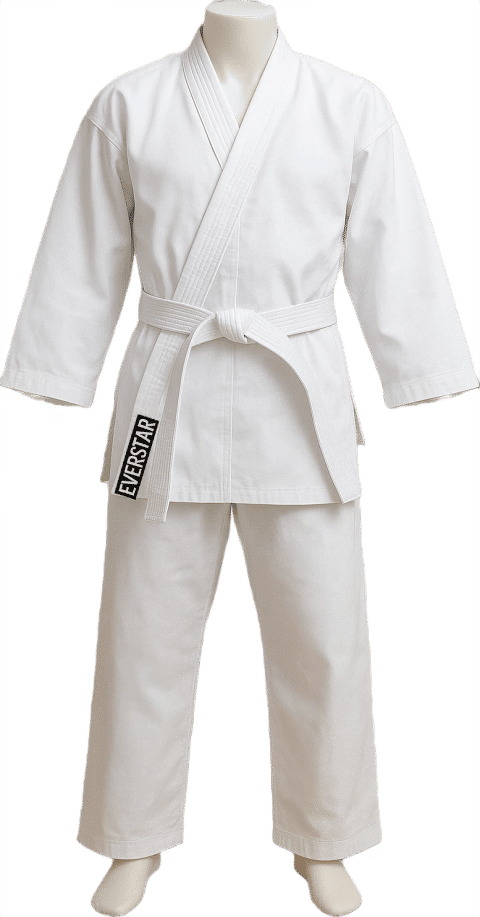
A karate belt is not just a rank marker — it is what holds the gi jacket closed through a full class, which is why length matters more than most beginners realise. A belt that is too short will not tie properly; one that is too long dangles into your stance and gets stepped on.
These are traditional cotton belts with multi-row stitching to hold their shape, available in 250cm, 285cm and 300cm.
Choosing your length
A karate belt wraps twice around the waist and ties in a square knot, leaving two tails that should hang roughly equal and finish somewhere around mid-thigh.
- 250cm — Children and smaller juniors.
- 285cm — Older juniors, teenagers and most adults. This is the size most people need.
- 300cm — Larger adults, or anyone who prefers a longer tail.
The quick check: your waist measurement in centimetres, doubled, plus about 100cm for the knot and tails. If your tails end up above the hip the belt is too short; if they reach the knee it is too long and will trip you in kata.
Tying it correctly
Find the middle of the belt and hold it against your abdomen. Take both ends around your back, cross them behind you, and bring them to the front. Cross the left end over the right, tuck it up under both layers, and pull snug. Then tie a square knot: right over left, through and pull.
The knot should sit centred and flat, and both tails should be roughly the same length. If your knot keeps twisting sideways, you have tied a granny knot rather than a square knot — undo it and reverse the direction of the second cross.
Care and tradition
There is an old tradition that a karate belt should never be washed, so that it carries the record of your training. It is a nice story, and hygienically it is not great advice for a belt worn against a sweaty gi several times a week.
The practical middle ground: wash it occasionally in cold water, by hand, and hang it to dry. Do not tumble dry, do not bleach and do not wash it with the gi on a hot cycle if it is a coloured belt, as the dye can run.