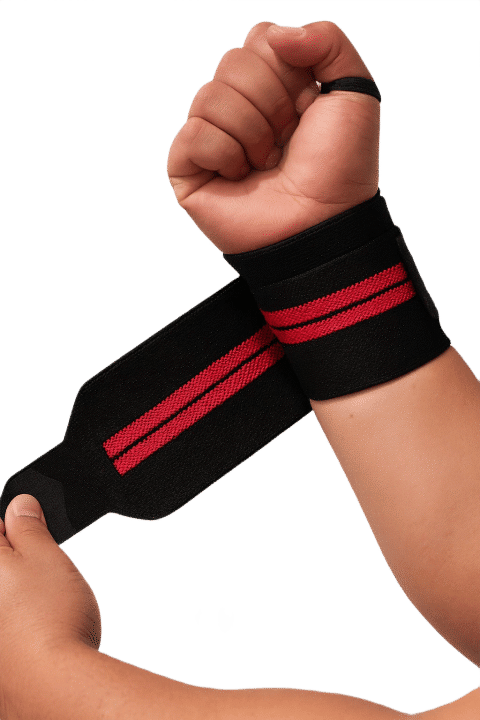
Knee wraps are a heavy squatting tool. Wrapped tightly around the knee, the elastic stores energy as you descend and returns some of it as you come out of the hole — which is why wrapped squats are measurably heavier than unwrapped ones for most lifters.
They also provide warmth and compression around the joint, which many lifters find valuable in cold weather or when managing a cranky knee. Elasticated cotton-blend wraps with a fastening tab.
Wraps are not knee sleeves
This distinction matters and gets confused constantly.
- Knee wraps — Long elastic strips wrapped tightly for each heavy set, then removed. They provide significant rebound and are a performance tool for maximal squats. Too tight to wear for a whole session.
- Knee sleeves — Pull-on neoprene tubes worn for the whole session. Warmth and compression, minimal rebound.
If you want joint warmth and light support across a training session, you want sleeves. If you want to squat heavier on top sets, you want wraps.
How to wrap
Start just below the kneecap with the leg straight or very slightly bent. Wrap upward in a spiral, overlapping each turn by roughly half the wrap's width, keeping firm even tension throughout.
Continue past the kneecap to just above it and fasten. It should feel very tight — tight enough that you would not want to walk around in them. Put them on immediately before your set and take them off immediately after. Leaving knee wraps on between sets restricts circulation and is genuinely uncomfortable.
Using them sensibly
Wraps are for heavy sets, not every set. Squatting wrapped all the time means your knees, tendons and stabilisers stop adapting to unwrapped load, which is not a good long-term trade.
They are also not a fix for knee pain. If your knee hurts when you squat, that needs a physiotherapist and a look at your technique — wrapping over a problem lets you keep loading a joint that is telling you to stop. Pair with a lifting belt for heavy squat work.

.webp?tr=w-480,q-80)